Horse Peak Gelatin Official Website › Blog › Boron And Eight Men
Boron At 7 mg And The Study Of Eight Men
Boron is the one botanical-adjacent row on this panel that sits inside the range its research used. It is also a row whose entire hormone reputation rests on eight men taking it for a week, with no control group. Both facts belong in the same post.
- Boron is a trace element with no established human requirement and no Daily Value.
- This label carries 7 mg, which is 35 per cent of the 20 mg adult upper intake level.
- The study behind its reputation gave 10 mg a day to eight men for one week.
- Seven milligrams is therefore 70 per cent of a researched dose, which almost no botanical row in this category can say.
- The wider boron literature, on bone and on magnesium handling, is more interesting than the hormone claim and far less quoted.
What boron is, and why it is on this label
Boron is a metalloid element that turns up in plants, in soil and in ordinary diets. It has no established requirement in humans, which is why its row carries a footnote symbol rather than a percentage: no Daily Value has been set for it.
It reaches supplement labels by two different routes. One is bone and joint health, where its effects on calcium, magnesium and vitamin D metabolism have been studied for decades. The other is the male vitality aisle, where a single small study has been doing an enormous amount of work since 2011.
The form matters, and this label names it
Boron glycinate is the element chelated to the amino acid glycine. It is one of several supplemental forms, chosen over borax and boric acid, and naming the form is something a reader should expect and frequently does not get. This panel names it.
The two human studies, in full
The entire human evidence base behind the hormone reading of boron is small enough to put in one table.
| Study | Who | Dose and duration | What it reported |
|---|---|---|---|
| Nielsen 1987 | 12 postmenopausal women in a metabolic unit | 3 mg a day after a depletion period | Changes in mineral, oestrogen and testosterone handling |
| Naghii 2011 | 8 healthy men | 10 mg a day for one week | A rise in free testosterone, with falls in sex hormone binding globulin and oestradiol |
| This label | Anybody who buys it | 7 mg a day, indefinitely | Not studied as a finished product |
Two human studies and a product. The middle row is the one quoted in most marketing for boron in this category.
The 1987 study put twelve postmenopausal women in a metabolic unit, depleted them of boron and then supplemented at 3 mg a day, observing changes in mineral handling and in circulating steroids. It is a careful piece of work and it is not about men.
The 2011 study is the one quoted everywhere. Eight healthy men took 10 mg of boron a day for one week. Free testosterone rose, sex hormone binding globulin and oestradiol fell, and several inflammatory markers moved.
Why eight men for a week is a weak foundation
This is not an attack on the study. It is a description of what a study of that size and shape can and cannot establish, and every one of these points would be made by the authors themselves.
- Eight participants. A sample that small cannot separate a real effect from ordinary variation between people.
- No control group. Everybody received boron, so there is nothing to compare the change against except the same men a week earlier.
- Seven days. Long enough to move a blood marker, nowhere near long enough to say anything about an outcome anybody cares about.
- Markers rather than outcomes. Free testosterone is a measurement. Whether moving it by this route changes how somebody feels or performs is a separate question the study did not ask.
- It has not been replicated at scale. Fifteen years later there is still no large randomised trial of boron and male hormones.
What follows from all that is modest and specific: boron at these amounts is interesting, it is not established, and a label carrying 7 mg is making a reasonable bet rather than delivering a proven intervention. This website will not state the 2011 result as an expectation and does not anywhere.
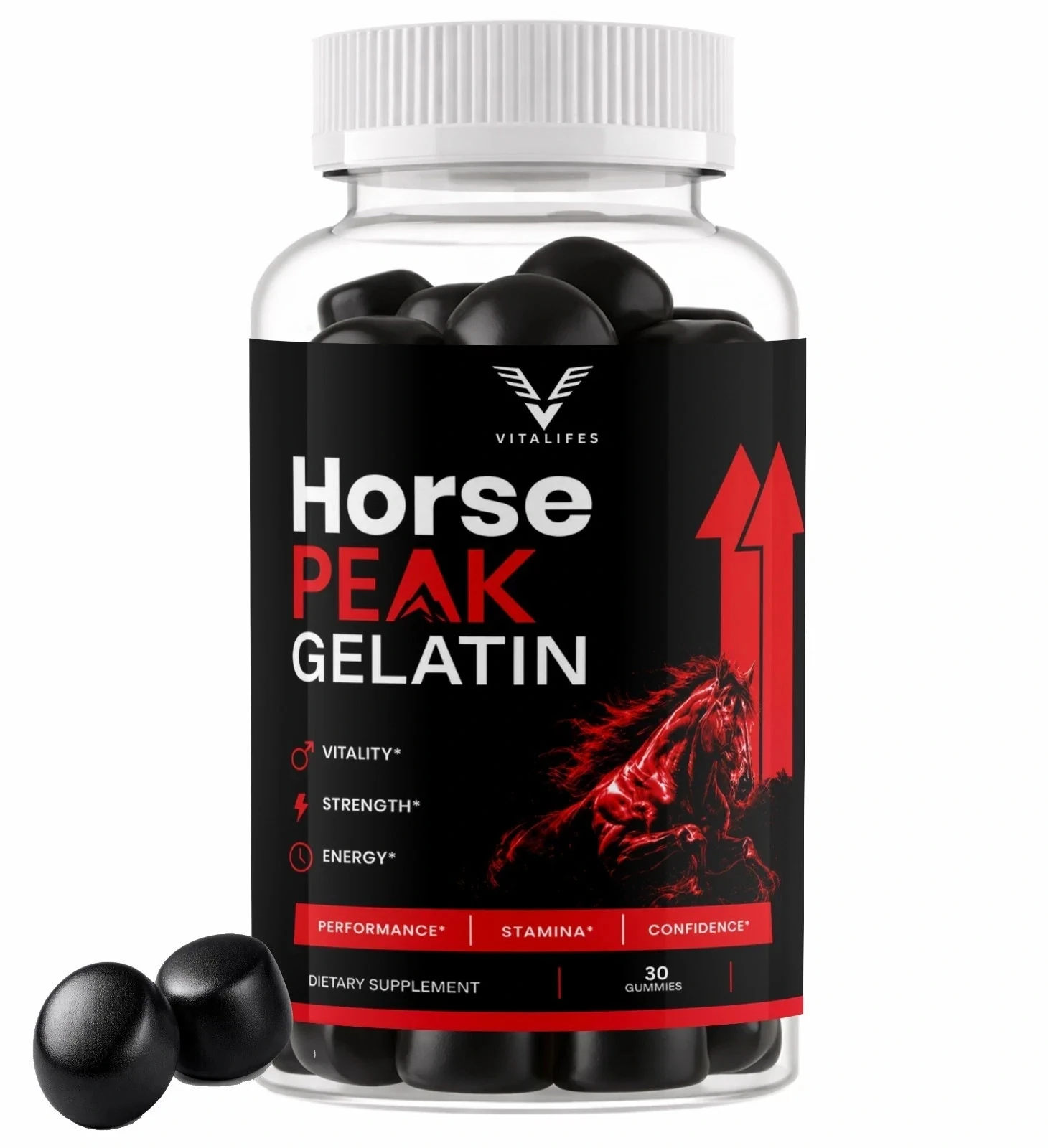
Boron at 7 mg is the row on the Horse Peak Gelatin panel that sits inside its own research
Printed plainly, with the study it borrows from named. 60 days from the date of purchase to change your mind.
Two bottles $158 · six bottles $294 · 60-day money-back guarantee
Order Horse Peak Gelatin On The Official WebsiteOne gummy a day · 30 per bottle · lot HOR-26/MY-5544
The boron literature nobody quotes
The hormone study gets the attention and the rest of the boron literature is more substantial, less exciting and considerably more useful.
A review of boron in human nutrition covers its effects on bone density, on the metabolism of calcium, magnesium and vitamin D, and on inflammatory markers. A 2026 review of boron as a dietary supplement brings that up to date and is the better starting point for anybody who wants to understand what the element actually does.
Two themes recur across both. Boron interacts with the same mineral system vitamin D works in, which makes its presence on a panel alongside 3,360 IU of vitamin D more coherent than it first looks. And the effects reported are generally modest and generally in people whose intake was low to begin with, which is the same pattern seen across most micronutrients.
How much boron an ordinary diet supplies
Boron is in fruit, nuts, legumes and wine. A person eating a mixed diet is already taking some, which is context this category almost never provides.
| Food | Roughly how much boron | As a share of this label's 7 mg |
|---|---|---|
| An apple | about 0.3 mg | 4% |
| A handful of raisins | about 0.9 mg | 13% |
| A serving of almonds | about 0.7 mg | 10% |
| An avocado | about 1.1 mg | 16% |
| A typical mixed Western day | 1 to 3 mg | 14 to 43% |
Approximate figures from food-composition work, included to show that ordinary diets already supply boron and that 7 mg is supplemental rather than replacement.
So 7 mg a day from a gummy is roughly three to seven times an ordinary dietary intake, added on top of it. That is a supplemental amount in the proper sense of the word: it supplements rather than replaces.
It also means anybody eating a great deal of dried fruit and nuts is starting from a higher baseline, which is worth a moment's thought before adding a second boron-containing product.
The ceiling, and where 7 mg sits against it
The Institute of Medicine set the adult upper intake level for boron at 20 mg a day. Seven milligrams is 35 per cent of that, leaving comfortable room for dietary boron and for the ordinary variation between one day and the next.
Adverse effects at supplemental doses are mostly digestive: nausea and loose stools have been reported at higher amounts. Nothing on this website has been reported at 7 mg, and the side effects page covers the panel row by row at the amounts actually printed.
What boron glycinate is, and why the form is named
Supplemental boron reaches the shelf in several forms and they are not interchangeable in the way a reader might assume.
Boric acid and sodium borate are the industrial compounds, used in supplements historically and largely displaced for consumer products. Boron citrate, boron aspartate and boron glycinate are chelates: the element bound to an organic acid or an amino acid, which is the arrangement generally preferred for supplemental minerals.
This label names boron glycinate, the glycine chelate. Naming the form at all is worth noting, because a panel that says simply boron leaves a reader unable to compare it with anything, and because the studies quoted above used specific preparations rather than the element in the abstract.
- The form affects absorption, at least in principle, though boron is well absorbed from most preparations.
- The form affects tolerance. Digestive upset at higher supplemental amounts is reported more often with some forms than others.
- The form is a proxy for care. A formulator who names it has thought about it.
- The amount still matters more. A well-chosen form at a token weight is still a token weight, which is the general lesson of this whole panel.
Why this row is the most honest one on the panel
Set the four figures side by side and the point makes itself.
- Fenugreek: 100 mcg against a 600 mg trial. About a six-thousandth.
- Maca: 100 mcg against 1,500 to 3,000 mg. About a twenty-thousandth.
- Tribulus: 100 mcg against 1,500 mg of a more concentrated extract.
- Boron: 7 mg against the 10 mg the study used. Seventy per cent.
Boron is the only row in that list where the label and the literature are in the same unit, let alone the same order of magnitude. Vitamin D3 is the other row that can say as much, and between them they are what this product actually delivers.
That is the argument the benefits page makes at greater length, and the reason this desk describes the bottle as a nutrient product with a botanical signature rather than as a herbal formula.
A second, larger, controlled trial of boron at 7 to 10 mg in men, run for more than a week. Nothing about the ingredient needs changing. What is missing is the evidence, and that is not something a formulator can print on a panel.
References
- Naghii MR, Mofid M, Asgari AR, et al. Comparative effects of daily and weekly boron supplementation on plasma steroid hormones and proinflammatory cytokines. J Trace Elem Med Biol. 2011;25(1):54-8. PMID 21129941. https://pubmed.ncbi.nlm.nih.gov/21129941/
- Nielsen FH, Hunt CD, Mullen LM, Hunt JR. Effect of dietary boron on mineral, estrogen, and testosterone metabolism in postmenopausal women. FASEB J. 1987;1(5):394-7. PMID 3678698. https://pubmed.ncbi.nlm.nih.gov/3678698/
- Pizzorno L. Nothing Boring About Boron. Integr Med (Encinitas). 2015;14(4):35-48. PMID 26770156. https://pubmed.ncbi.nlm.nih.gov/26770156/
- Kuru-Yasar R, Yarat A. The Role of Boron in the Diet and as a Dietary Supplement. Handb Exp Pharmacol. 2026. PMID 42185672. https://pubmed.ncbi.nlm.nih.gov/42185672/
- Institute of Medicine (US) Panel on Micronutrients. Arsenic, Boron, Nickel, Silicon, and Vanadium. In: Dietary Reference Intakes for Vitamin A, Vitamin K, Arsenic, Boron, Chromium, Copper, Iodine, Iron, Manganese, Molybdenum, Nickel, Silicon, Vanadium, and Zinc. Washington (DC): National Academies Press (US); 2001. https://www.ncbi.nlm.nih.gov/books/NBK222322/