Horse Peak Gelatin Official Website › Ingredients
IngredientsHorse Peak Gelatin Ingredients: What Is in Each Gummy
Each Horse Peak Gelatin gummy has six actives with printed amounts and no hidden blend.
Vitamin D3 leads at 84 mcg (3,360 IU), then boron at 7 mg. Fenugreek, maca, tribulus and horny goat weed are 10:1 extracts at 100 mcg each.
Six names, six amounts, and the chemistry behind each one.
Every name on the Horse Peak Gelatin label, in panel order
Six actives and one mineral salt, with the amount the bottle prints against each.
| Row | Per gummy | Form named on the label |
|---|---|---|
| Vitamin D3 | 84 mcg | Cholecalciferol, the animal-form vitamin D |
| Sodium | 10 mg | Sodium citrate, a salt of citric acid |
| Boron | 7 mg | Boron glycinate, the mineral bound to an amino acid |
| Fenugreek seed | 100 mcg | A 10:1 seed extract, binomial printed |
| Maca root | 100 mcg | A 10:1 root extract, binomial printed |
| Tribulus terrestris | 100 mcg | A 10:1 extract, binomial misprinted |
| Horny goat weed | 100 mcg | A 10:1 leaf extract of Epimedium |
Read off the bottle artwork at magnification. Seven rows carry an active; the four nutrition lines above them are the calorie and sugar figures, which the supplement facts page sets out in full.
Seven rows, seven numbers, no proprietary blend and no phrase standing in for an amount. That is a better starting position than a great many bottles in this aisle offer, and it is the reason every sentence below can be specific.
The order above is the label's own. Vitamin D3 and sodium sit in the nutrient block with a percentage of the Daily Value beside them, boron follows with a footnote symbol because no Daily Value exists for it, and the four botanicals close the panel at an identical 100 micrograms each.
What form does each Horse Peak Gelatin ingredient take?
Six rows, six named chemical forms, which is more than the category norm.
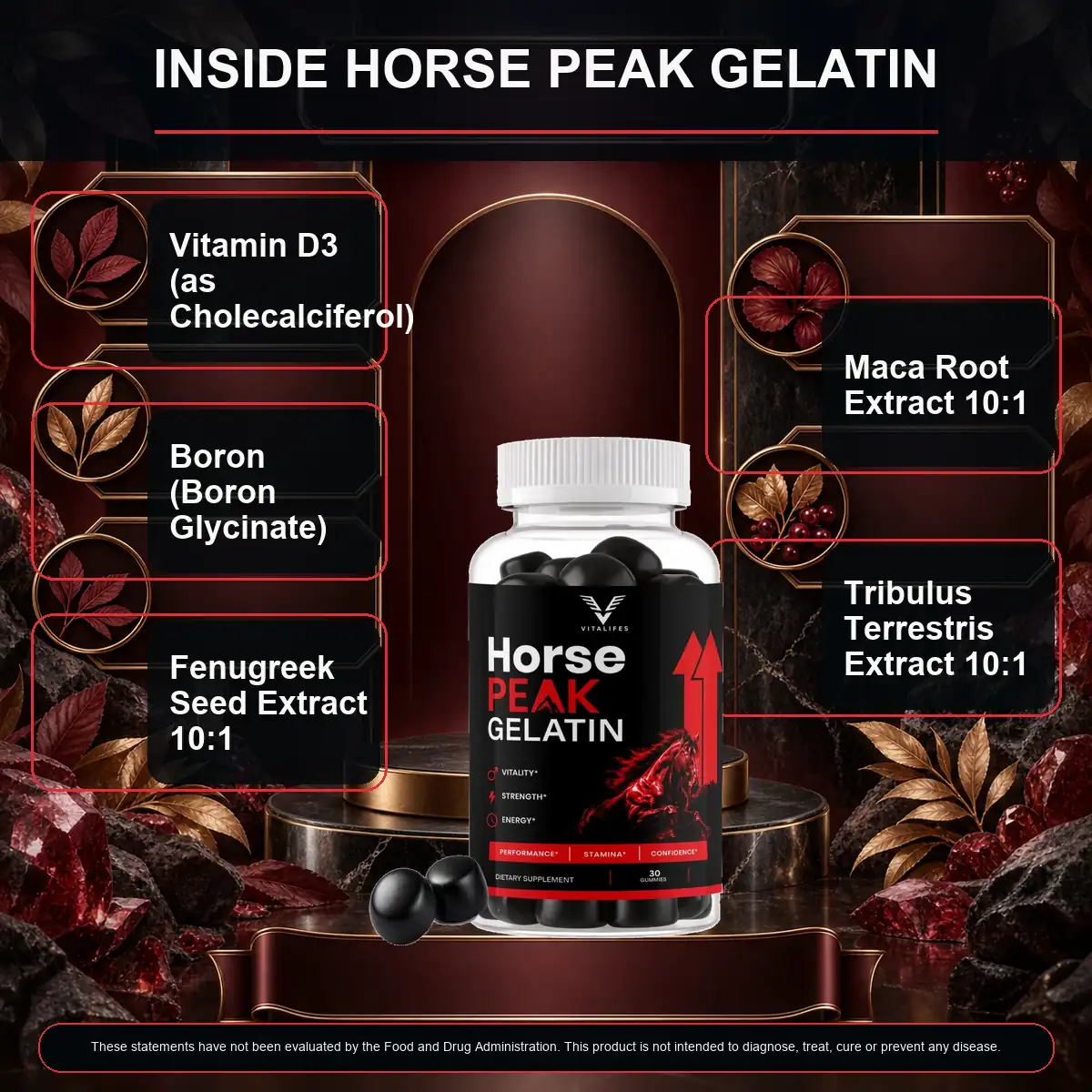
A form is not a detail. Two products can both say boron and deliver different compounds at different absorptions, and the label is the only place the answer is written down. This one writes it down for every row.
Boron glycinate is the mineral chelated to the amino acid glycine, a form chosen over borax and boric acid for supplement use. Vitamin D3 is cholecalciferol, the form made in skin and the one used in most modern supplementation trials, rather than the plant-derived D2. Sodium arrives as sodium citrate, which is a buffering salt doing a job in the gummy rather than a nutrient anybody is short of.
The four botanicals are all given as 10:1 extracts with the plant part named for three of them. Naming the part matters: a root and a leaf from one plant are two different raw materials with two different chemistries.
The six Horse Peak Gelatin actives, one card at a time
Each row with its form, its printed amount and the amount its own published work used.
Vitamin D3
as cholecalciferol84 mcg · 3,360 IUThe largest real dose on this panel and the one row that needs no argument. Eighty-four micrograms converts to 3,360 international units, which is 420 per cent of the 20 mcg Daily Value and 84 per cent of the 4,000 IU adult upper intake level. A gummy delivering that much of a nutrient is delivering something.
What it is good for is the ordinary business of vitamin D: bone, muscle and immune function, and correcting a shortfall in somebody who has one. The vitality reading of it is thinner, and the 2026 meta-analysis of vitamin D and testosterone is where that thinness is documented.
Boron
as boron glycinate7 mgThe row with the most interesting arithmetic. Seven milligrams is 35 per cent of the 20 mg adult upper intake level and 70 per cent of the 10 mg a day used in the single human study that reported a rise in free testosterone. Whatever that study is worth, this label is inside its range rather than gesturing at it.
Boron is a trace element with no Daily Value set, which is why its row carries a footnote symbol instead of a percentage. Ordinary diets supply one to three milligrams a day from fruit, nuts and legumes, so seven is a supplemental amount rather than a token one.
Fenugreek seed extract
Trigonella foenum-graecum L., seed, 10:1100 mcgA kitchen spice with a genuine clinical literature behind it, and the row where the distance between label and literature opens up. The twelve-week trial in aging men ran 600 mg a day of a standardised seed extract. The 2024 dose-ranging study went to 600, 1,200 and 1,800 mg.
One hundred micrograms is a ten-thousandth of a gram. Working the 10:1 ratio backwards puts about one milligram of raw seed behind it, which is less than a pinch of the spice in a curry.
Maca root extract
Lepidium meyenii Walp., root, 10:1100 mcgA Peruvian cruciferous root eaten as food at the top of the Andes, which is part of why its safety record is reassuring and its trial doses are large. The trial that made its name compared 1,500 and 3,000 mg a day against placebo over twelve weeks.
Maca is a food-dose ingredient. A safety and acceptability study ran 3 g a day without trouble, which tells you the material is benign and tells you nothing about a hundred micrograms of it.
Tribulus terrestris extract
10:1, binomial misprinted on the panel100 mcgThe row where this panel makes a printing error worth naming. The Tribulus line carries fenugreek’s binomial, Trigonella foenum-graecum L., where Tribulus terrestris L. belongs. It is a typesetting mistake rather than a substitution claim, and the supplement facts page lists all four misprints in one place.
On the ingredient itself: the 1,500 mg trial used a 35 to 45:1 extract standardised to at least 112.5 mg of furostanol saponins, while an 800 mg arm performed no better than placebo. Strength of extract and standardisation both sit above weight in what makes a tribulus row mean anything.
Horny goat weed extract
Epimedium, leaf, 10:1100 mcgEpimedium is the traditional Chinese herb whose interest rests on icariin, a flavonoid that behaves like a weak phosphodiesterase-5 inhibitor in glassware. The 2022 review of what icariin has and has not shown is the honest summary: cells, rodents and a great deal of enthusiasm.
There is no human oral dosing trial to set this row against, which makes it the only one of the six where a comparison cannot be drawn at all. Epimedium material also varies widely between suppliers, so two labels printing the same weight need not be selling the same thing.
What does 10:1 mean on the Horse Peak Gelatin label?
A ratio describes a manufacturing step, not a dose.
Four of the six actives carry the notation 10:1, and it is the single most misunderstood mark in the supplement aisle. It describes how the extract was made: ten parts of raw plant material reduced down to one part of finished extract.
It is not a strength rating, and it cannot be verified after the fact. The United States Pharmacopeia group’s own paper on the subject says plainly that plant-to-extract ratios are descriptive, that no analytical method can confirm one, and that they are nonetheless routinely used as though they were a measure of potency for dosage calculations.
The practical consequence is a multiplication a buyer can do at the shelf. One hundred micrograms of a 10:1 extract represents roughly one milligram of the original herb. Four of those rows together represent about four milligrams of plant matter in a gummy that weighs several grams.
100 mcg of a 10:1 extract works back to about 1 mg of raw herb. Whether the extract concentrates the compounds that matter is a separate question no ratio answers, which is why standardisation to a named marker is the mark worth looking for and none of these four rows carries one.
Honest dosage analysis: the four 100-microgram Horse Peak Gelatin rows
Two amounts on this panel are doing work and four are doing very little, and the panel itself is what makes that visible. A label hiding its botanicals inside a proprietary blend would not let anyone check.
Set against raw herb rather than against extract weight, the four botanical rows come to roughly four milligrams of plant material between them. A single teaspoon of fenugreek seed is about four grams, which is a thousand times the whole botanical content of one gummy.
| Row | Label | Works back to | Trial material |
|---|---|---|---|
| Fenugreek | 100 mcg of a 10:1 extract | about 1 mg of seed | 600 mg a day of standardised extract |
| Maca | 100 mcg of a 10:1 extract | about 1 mg of root | 1,500 to 3,000 mg a day |
| Tribulus | 100 mcg of a 10:1 extract | about 1 mg of herb | 1,500 mg a day of a 35-45:1 extract |
| Horny goat weed | 100 mcg of a 10:1 extract | about 1 mg of leaf | no human oral dosing trial exists |
The middle column is the 10:1 ratio worked backwards. The right-hand column is what the published studies administered, and is not a prediction about this gummy.
None of that makes the four rows harmful, and none of it makes the two working rows less real. It makes the bottle a vitamin D and boron product with a botanical signature on the label, and a buyer who reads it that way will not be disappointed by it.
The one line the Horse Peak Gelatin label leaves out
One statement is absent from this artwork, and it is the one a gummy usually leads with.
Every finished supplement has a second list under the actives: the gelling agent, the sweetener, the colour, the coating. On a gummy it is usually the longest part of the label, because a gummy is mostly matrix by weight.
This artwork carries the actives, the nutrition block, the serving size, the container count, the storage line, a full caution and an expiry date. It carries no other-ingredients statement at all. For a product with the word Gelatin in its name, that leaves the gelling agent and its animal source unstated, and it is the single most useful question to put to the order desk before buying.
Somebody already knows the answer. Laboratories tell bovine gelatin from porcine as a matter of routine, so this is a question of disclosure rather than of science. What the panel does describe is the sugar: 4 g of carbohydrate and 3 g of total sugars a gummy, which puts the matrix at roughly 7,500 times the weight of everything botanical in it.
Horse Peak Gelatin ingredient questions
How many active ingredients are in Horse Peak Gelatin?
Six, plus sodium as sodium citrate. Vitamin D3, boron, fenugreek, maca, tribulus and horny goat weed, with an amount printed against every one of them and nothing hidden inside a blend.
Does Horse Peak Gelatin contain caffeine or a stimulant?
No caffeine, no yohimbine and no stimulant appears anywhere on the panel. Nothing on this label produces a sensation on the afternoon you take it, which is worth knowing before the first gummy rather than after it.
Is there a proprietary blend in Horse Peak Gelatin?
There is not. Every row carries its own weight in milligrams or micrograms, which is the arrangement that lets the rest of this website compare each amount with the amount its own research used.
Which ingredient is the largest by weight?
Boron, at 7 mg. Sodium follows at 10 mg but is a salt in the confection rather than an active anybody buys the product for. Vitamin D3 is 84 micrograms, which is small by weight and large as a dose of that particular nutrient.
Is Horse Peak Gelatin vegetarian?
The pack ships a vegetarian badge and the label names no gelling agent, so the two cannot be reconciled from the artwork alone. The testing and quality page audits that badge along with the other nine, and the order desk can be asked for the finished-product specification.
Does the gummy contain sugar?
Yes. Four grams of total carbohydrate and three grams of total sugars per gummy, with zero added sugars declared, and twenty calories. Anyone counting either number will want it in front of them, and it is printed in full on the supplement facts page.
Sources for the Horse Peak Gelatin ingredient list
Every study named above, in the order the panel lists the ingredient it belongs to.
- Paez-Allendes L, Valenzuela-Fuenzalida JJ, Moya MP, et al. Vitamin D Supplementation, Total Testosterone, and Androgen Bioavailability Markers in Adult Men: A Systematic Review and Meta-Analysis of Randomized Controlled Trials. Nutrients. 2026;18(13). PMID 42451097. https://pubmed.ncbi.nlm.nih.gov/42451097/
- Institute of Medicine (US) Committee to Review Dietary Reference Intakes for Vitamin D and Calcium; Ross AC, Taylor CL, Yaktine AL, Del Valle HB, editors. Tolerable Upper Intake Levels: Calcium and Vitamin D. In: Dietary Reference Intakes for Calcium and Vitamin D. Washington (DC): National Academies Press (US); 2011. https://www.ncbi.nlm.nih.gov/books/NBK56058/
- Naghii MR, Mofid M, Asgari AR, et al. Comparative effects of daily and weekly boron supplementation on plasma steroid hormones and proinflammatory cytokines. J Trace Elem Med Biol. 2011;25(1):54-8. PMID 21129941. https://pubmed.ncbi.nlm.nih.gov/21129941/
- Institute of Medicine (US) Panel on Micronutrients. Arsenic, Boron, Nickel, Silicon, and Vanadium. In: Dietary Reference Intakes for Vitamin A, Vitamin K, Arsenic, Boron, Chromium, Copper, Iodine, Iron, Manganese, Molybdenum, Nickel, Silicon, Vanadium, and Zinc. Washington (DC): National Academies Press (US); 2001. https://www.ncbi.nlm.nih.gov/books/NBK222322/
- Rao A, Steels E, Inder WJ, et al. Testofen, a specialised Trigonella foenum-graecum seed extract reduces age-related symptoms of androgen decrease, increases testosterone levels and improves sexual function in healthy aging males in a double-blind randomised clinical study. Aging Male. 2016;19(2):134-42. PMID 26791805. https://pubmed.ncbi.nlm.nih.gov/26791805/
- Lee-Odegard S, Gundersen TE, Drevon CA. Effect of a plant extract of fenugreek (Trigonella foenum-graecum) on testosterone in blood plasma and saliva in a double blind randomized controlled intervention study. PLoS One. 2024;19(9):e0310170. PMID 39288153. https://pubmed.ncbi.nlm.nih.gov/39288153/
- Gonzales GF, Cordova A, Vega K, et al. Effect of Lepidium meyenii (MACA) on sexual desire and its absent relationship with serum testosterone levels in adult healthy men. Andrologia. 2002;34(6):367-72. PMID 12472620. https://pubmed.ncbi.nlm.nih.gov/12472620/
- Gonzales-Arimborgo C, Yupanqui I, Montero E, et al. Acceptability, Safety, and Efficacy of Oral Administration of Extracts of Black or Red Maca (Lepidium meyenii) in Adult Human Subjects: A Randomized, Double-Blind, Placebo-Controlled Study. Pharmaceuticals (Basel). 2016;9(3). PMID 27548190. https://pubmed.ncbi.nlm.nih.gov/27548190/
- Kamenov Z, Fileva S, Kalinov K, Jannini EA. Evaluation of the efficacy and safety of Tribulus terrestris in male sexual dysfunction-A prospective, randomized, double-blind, placebo-controlled clinical trial. Maturitas. 2017;99:20-26. PMID 28364864. https://pubmed.ncbi.nlm.nih.gov/28364864/
- Santos CA Jr, Reis LO, Destro-Saade R, et al. Tribulus terrestris versus placebo in the treatment of erectile dysfunction: A prospective, randomized, double blind study. Actas Urol Esp. 2014;38(4):244-8. PMID 24630840. https://pubmed.ncbi.nlm.nih.gov/24630840/
- Niu Y, Lin G, Pan J, et al. Deciphering the myth of icariin and synthetic derivatives in improving erectile function from a molecular biology perspective: a narrative review. Transl Androl Urol. 2022;11(7):1007-1022. PMID 35958901. https://pubmed.ncbi.nlm.nih.gov/35958901/
- Yong EL, Wong SP, Shen P, et al. Standardization and evaluation of botanical mixtures: lessons from a traditional Chinese herb, Epimedium, with oestrogenic properties. Novartis Found Symp. 2007;282:173-88. PMID 17913231. https://pubmed.ncbi.nlm.nih.gov/17913231/
- Monagas M, Brendler T, Brinckmann J, et al. Understanding plant to extract ratios in botanical extracts. Front Pharmacol. 2022;13:981978. PMID 36249773. https://pubmed.ncbi.nlm.nih.gov/36249773/
- Nikzad J, Shahhosseini S, Tabarzad M, et al. Simultaneous detection of bovine and porcine DNA in pharmaceutical gelatin capsules by duplex PCR assay for Halal authentication. Daru. 2017;25(1):3. PMID 28196517. https://pubmed.ncbi.nlm.nih.gov/28196517/
Order Horse Peak Gelatin with all six amounts in front of you
Six actives, six printed figures, 30 gummies to a bottle and 60 days from the date of purchase to change your mind.
Two bottles $158 · six bottles $294 · 60-day money-back guarantee
Order Horse Peak Gelatin On The Official WebsiteOne gummy a day · 30 per bottle · lot HOR-26/MY-5544