Horse Peak Gelatin Official Website › Blog › Vitamin D And The Ceiling
3,360 IU In A Gummy: Vitamin D And The 4,000 IU Ceiling
Eighty-four micrograms sounds like nothing and is 84 per cent of the adult upper intake level. This is the largest real dose on this panel, the one row most likely to do something, and the only one worth adding up against the rest of your cupboard.
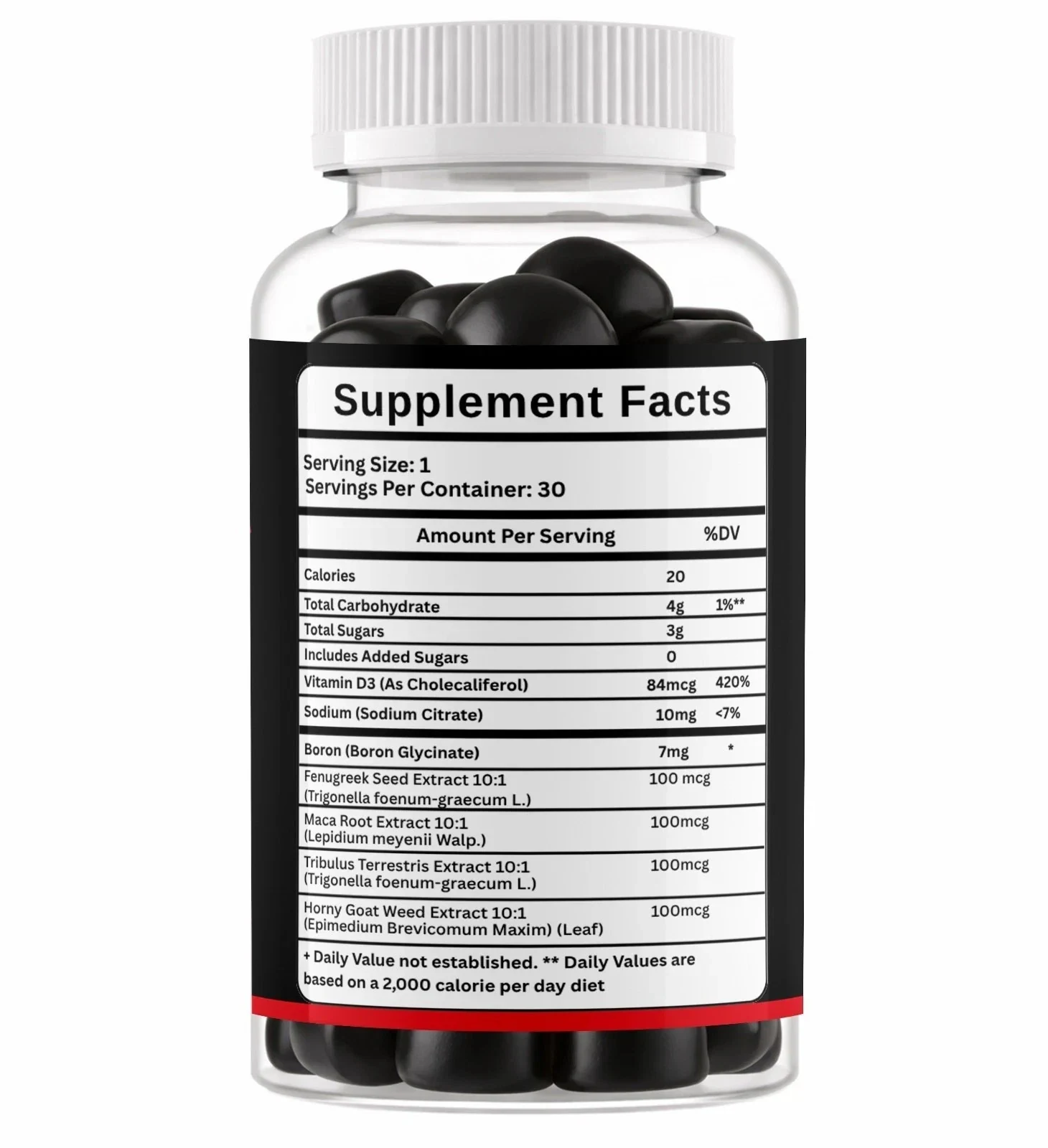
- One microgram of vitamin D is 40 international units, so 84 mcg is 3,360 IU.
- The adult tolerable upper intake level is 4,000 IU a day, which makes this gummy 84 per cent of it on its own.
- Vitamin D has an established role in bone, muscle and immune function. Its effect on sex hormones is thin.
- A second vitamin D product on top of this one needs adding up before it is started, not after.
- Going over the ceiling occasionally is not the same as being harmed by it, and documented toxicity involves far larger amounts for far longer.
The conversion that trips everyone up
Vitamin D is printed in micrograms on a modern panel and discussed in international units almost everywhere else. The two numbers describe the same thing and look nothing alike, which is how a large dose ends up reading as a small one.
The conversion is fixed: one microgram is 40 international units. Multiply the panel figure by forty and the number people actually recognise appears.
| Printed as | Equals | As a share of the 4,000 IU adult ceiling |
|---|---|---|
| 10 mcg | 400 IU | 10% |
| 25 mcg | 1,000 IU | 25% |
| 50 mcg | 2,000 IU | 50% |
| 84 mcg | 3,360 IU | 84% |
| 100 mcg | 4,000 IU | 100% |
One microgram of vitamin D is 40 international units. That single conversion explains why the same dose looks small on one label and large on another.
Eighty-four micrograms is the second-largest figure in that table and it is printed on a gummy that also carries four botanicals at a ten-thousandth of a gram each. The contrast is the most interesting thing about this panel.
The 420 per cent of Daily Value beside it is correct arithmetic against the 20 mcg reference figure, and it is a separate question from the ceiling. A Daily Value is a reference intake; an upper intake level is a limit. Confusing them is common and it is why 420 per cent alarms people who should be reading 84 per cent instead.
What the ceiling is, and what it is not
The Institute of Medicine set the adult tolerable upper intake level at 4,000 IU a day for everyone from nineteen upward. That figure appears on this website repeatedly and it is worth understanding rather than merely quoting.
What it means
It is the highest daily intake likely to pose no risk of adverse effects for almost everybody, taken continuously over time. It is set with a safety margin and it is about habitual intake rather than any single day.
What it does not mean
It is not a cliff. Nothing happens at 4,001 IU that did not happen at 3,999. It is not a target either: being close to it confers no benefit and the range where vitamin D does its work is well below it for most people.
An appraisal of the 2024 Endocrine Society guideline is a fair place to read how the professional bodies currently frame routine supplementation, and it is more nuanced than either the alarmed or the enthusiastic version of this subject.
Where vitamin D hides in an ordinary cupboard
This is the practical heart of the post. Vitamin D is cheap, popular and useful, so it gets added to products that are sold for something else entirely.
| Where vitamin D turns up | Typical amount per daily dose | Does the front of the box say so? |
|---|---|---|
| A standalone vitamin D capsule | 1,000 to 5,000 IU | Yes |
| A general multivitamin | 400 to 1,000 IU | Rarely on the front |
| A calcium supplement | 200 to 800 IU | Sometimes |
| A bone or joint formula | 400 to 2,000 IU | Rarely |
| Cod liver oil | 400 to 1,200 IU | Rarely on the front |
| This gummy | 3,360 IU | The panel prints 84 mcg, which is the same thing |
Typical ranges across ordinary retail products, given so a reader can audit his own cupboard. Read the panel on each one rather than the front of the box.
A man taking this gummy and an ordinary multivitamin is somewhere between 3,760 and 4,360 IU a day. A man taking this gummy and a 2,000 IU capsule because somebody told him vitamin D was good for him is at 5,360, which is above the ceiling every day rather than occasionally.
Neither of those is an emergency. Both are worth knowing about, and both take one minute with the bottles on a kitchen table to establish.
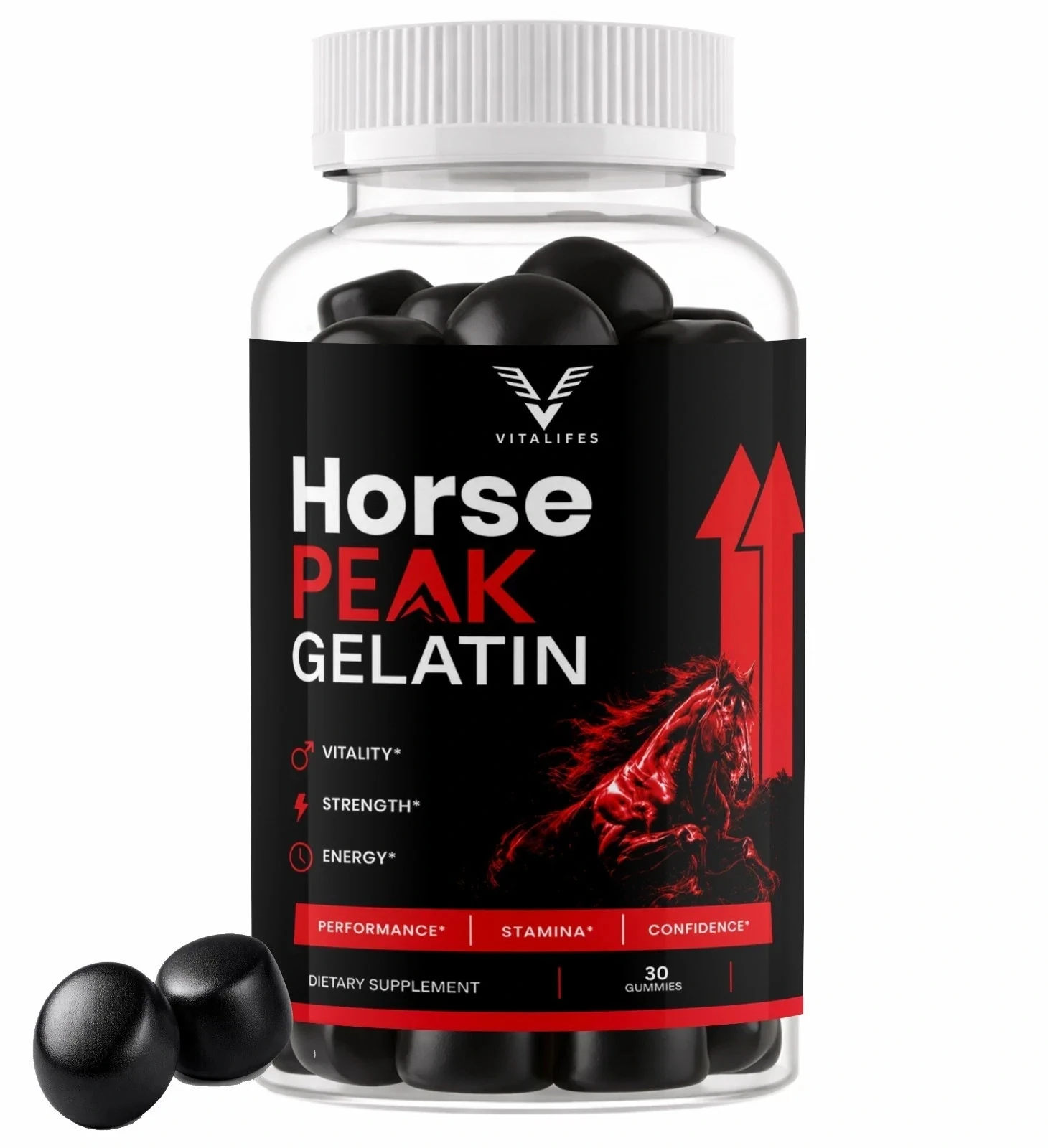
Horse Peak Gelatin prints 84 mcg on the panel, so the arithmetic is there to do
One gummy a day, 30 to a bottle, and 60 days from the date of purchase to change your mind.
Two bottles $158 · six bottles $294 · 60-day money-back guarantee
Order Horse Peak Gelatin On The Official WebsiteOne gummy a day · 30 per bottle · lot HOR-26/MY-5544
What the nutrient reliably does
Vitamin D is not active as swallowed. The liver converts cholecalciferol to 25-hydroxyvitamin D, which is the form a blood test measures, and the kidney converts that to the hormone the body uses. The whole sequence is why vitamin D status moves over weeks rather than hours.
- Calcium absorption and bone mineralisation. The original and least disputed role.
- Muscle function. Deficiency is associated with weakness and, in older adults, with falls.
- Immune function. A large literature with a more complicated conclusion than the headlines suggest.
- Correcting a shortfall. The honest summary of all three: the clearest benefits belong to people who were short and stopped being short.
That last point is the one to carry into a purchase. A supplement that corrects a deficiency is doing something real. The same supplement taken by somebody whose level was already comfortable is adding intake without adding much outcome.
What it does not reliably do
Vitamin D appears on male vitality labels because low levels have been observed alongside low testosterone in cross-sectional work. Observation is not effect, and the randomised evidence has been tested directly.
A trial in 307 infertile men gave a loading dose followed by 1,400 IU a day with calcium for 150 days and found no overall difference in sex steroids. Only a subgroup with the lowest starting levels showed a change in the testosterone to luteinising hormone ratio.
A 2026 meta-analysis pooled the randomised trials of vitamin D supplementation and androgen markers in adult men. It is the best available answer to the question and it does not support treating this row as a hormone intervention.
So the vitamin D3 on this label is a genuine nutrient dose, sold in a category that implies something it has not been shown to do. Neither half of that cancels the other, and this website prints them together.
Who is likely to be short of it
Deficiency is not rare and its risk factors are unglamorous.
- Indoor work through the winter, in any northern latitude.
- Darker skin, which reduces cutaneous synthesis at a given exposure.
- Older age, which reduces it further.
- Consistent sunscreen use, which is otherwise entirely sensible.
- Obesity, which sequesters the vitamin in adipose tissue.
- A diet with little oily fish, egg yolk or fortified food in it.
A 25-hydroxyvitamin D blood test settles the question in a way no amount of reasoning can. It is inexpensive, it is the single most useful number anybody taking this product could have, and it converts the largest row on this panel from a guess into a measurement.
Auditing your own intake in five minutes
- Put every supplement bottle you take on the table.
- Turn each one over and read the panel rather than the front.
- Write down the vitamin D figure from each, converting micrograms to IU by multiplying by forty.
- Add them together, including the 3,360 IU from this gummy.
- Compare the total against 4,000 IU. If it is over, the question is which product to drop rather than whether to worry.
This gummy is 84 per cent of the adult daily ceiling on its own, so almost any second vitamin D product takes the total over it. That is the arithmetic, and it is why the who it is for page names anyone already supplementing vitamin D as a poor fit for this product.
What genuinely too much looks like
Vitamin D toxicity is real, rare and produced by amounts an order of magnitude beyond anything discussed above. It works through hypercalcaemia: nausea, thirst, frequent urination, confusion, and in severe cases kidney damage.
A 2026 case report of intoxication from over-supplementation is the shape of it, and the amounts involved in such cases are typically tens of thousands of international units a day sustained over months.
Nothing about one gummy a day approaches that. The reason to do the arithmetic is not fear of toxicity; it is that there is no benefit in exceeding the ceiling and there is no reason to pay for two products doing the same job.
The side effects page covers the rest of this panel the same way, row by row, at the amounts actually printed on it.
References
- Institute of Medicine (US) Committee to Review Dietary Reference Intakes for Vitamin D and Calcium; Ross AC, Taylor CL, Yaktine AL, Del Valle HB, editors. Tolerable Upper Intake Levels: Calcium and Vitamin D. In: Dietary Reference Intakes for Calcium and Vitamin D. Washington (DC): National Academies Press (US); 2011. https://www.ncbi.nlm.nih.gov/books/NBK56058/
- Gordon L, Zipursky R, Cheung CC, et al. Vitamin D Intoxication in an Adolescent due to Over-Supplementation: A Case Report and Review of Literature. AACE Endocrinol Diabetes. 2026;13(1):93-97. PMID 41641290. https://pubmed.ncbi.nlm.nih.gov/41641290/
- Paez-Allendes L, Valenzuela-Fuenzalida JJ, Moya MP, et al. Vitamin D Supplementation, Total Testosterone, and Androgen Bioavailability Markers in Adult Men: A Systematic Review and Meta-Analysis of Randomized Controlled Trials. Nutrients. 2026;18(13). PMID 42451097. https://pubmed.ncbi.nlm.nih.gov/42451097/
- Holt R, Yahyavi SK, Kooij I, et al. Effects of vitamin D on sex steroids, luteinizing hormone, and testosterone to luteinizing hormone ratio in 307 infertile men. Andrology. 2024;12(3):553-560. PMID 37555466. https://pubmed.ncbi.nlm.nih.gov/37555466/
- Pilz S, Pludowski P, Kraus DA, et al. The 2024 Endocrine Society Guideline on Vitamin D: Comprehensive Summary and Critical Appraisal. Nutrients. 2026;18(9). PMID 42124073. https://pubmed.ncbi.nlm.nih.gov/42124073/