Horse Peak Gelatin Official Website › Blog › What 100 Micrograms Buys
What 100 Micrograms Of A Herb Actually Buys You
Four of the six actives on this label are dosed at 100 micrograms each. That is a real number printed honestly on a panel, and it is small enough that most readers have no intuition for it at all. This post gives the number a scale.
- A microgram is a millionth of a gram. One hundred of them is a ten-thousandth of a gram.
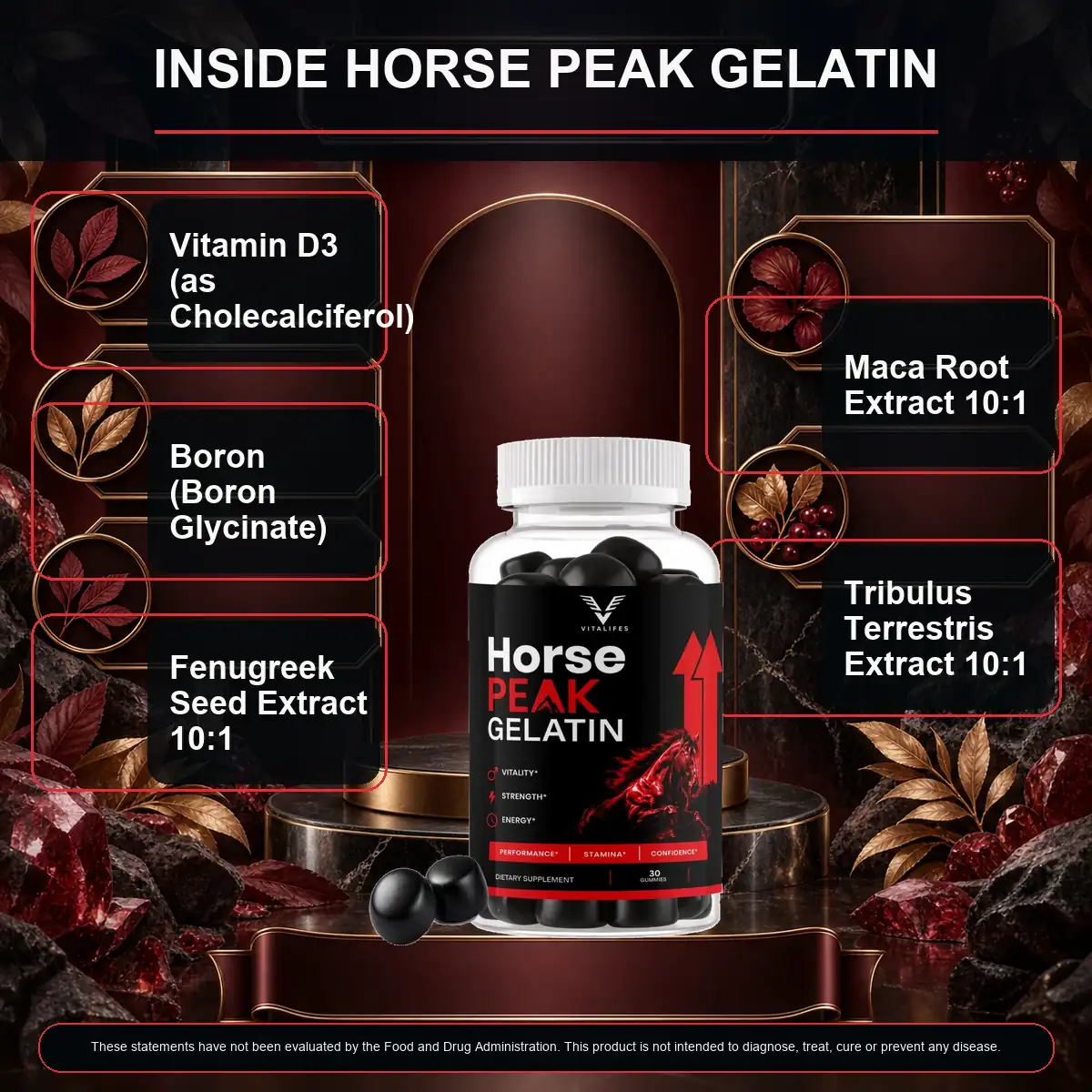
- Four rows on this panel carry that amount: fenugreek, maca, tribulus and horny goat weed.
- The trials behind those four herbs ran at 600 mg to 3,000 mg a day, which is thousands of times larger.
- Printing the figure is what makes this checkable. A proprietary blend would have hidden it.
- A token amount is not a fraudulent one. It is an ingredient carrying a name rather than a dose, and the two things are worth telling apart.
What a microgram actually is
Supplement panels move between three units without warning and most readers never notice the gear change. Grams, milligrams and micrograms sit within a thousand of each other, and a panel that runs 84 mcg, 10 mg, 7 mg, 100 mcg down a single column is asking a lot of anybody reading it on a phone in a kitchen.
A gram is about the weight of a paperclip. A milligram is a thousandth of that. A microgram is a thousandth of a milligram, which is a millionth of the paperclip.
Putting 100 micrograms next to things you can see
Numbers this small only become real by comparison, so here are five that most people can picture.
| Everyday thing | Roughly how much it weighs | How many 100 mcg doses that is |
|---|---|---|
| A grain of table salt | about 60 micrograms | less than one |
| A grain of granulated sugar | about 600 micrograms | six |
| A single dried peppercorn | about 40 milligrams | four hundred |
| A quarter-teaspoon of ground spice | about 500 milligrams | five thousand |
| A standard 500 mg capsule of powder | 500 milligrams | five thousand |
Approximate household weights, given so the unit stops being abstract. A microgram is a millionth of a gram and a milligram is a thousandth.
A hundred micrograms is roughly a sixth of a single grain of granulated sugar. That is the amount of fenugreek extract in one gummy, and the same again of maca, of tribulus and of Epimedium.
It is worth saying immediately that small is not automatically wrong. Vitamin D3 on this same panel is 84 micrograms and that is a substantial dose of that particular nutrient, because vitamins work at concentrations plant material does not. The unit is not the problem. The comparison is.
The four rows that carry the number
Reading down the panel, the four are identical to one another and identically labelled: a 10:1 extract at 100 micrograms, with the plant part named for three of them.
- Fenugreek seed extract 10:1, with the binomial Trigonella foenum-graecum L. printed correctly.
- Maca root extract 10:1, Lepidium meyenii Walp., with the part named.
- Tribulus terrestris extract 10:1, whose row carries fenugreek's binomial by mistake. It is one of four printing errors set out on the supplement facts page.
- Horny goat weed extract 10:1, Epimedium, leaf.
Four identical amounts in a row is itself informative. Formulation decisions rarely produce four different botanicals at precisely the same weight; a signature does.
None of that is hidden. The panel prints all four figures, which is more than a great many labels in this category manage, and it is the only reason this post can be written at all.
What the trials behind those names administered
Each of those four herbs has a research literature attached to its name. What follows is what those studies actually gave people, taken from the papers rather than from anybody's summary of them.
The best-known fenugreek trial ran 600 mg a day of a standardised seed extract for twelve weeks in men aged 43 to 70. A 2024 dose-ranging study went further, testing 600, 1,200 and 1,800 mg a day.
The maca trial that made its name compared 1,500 and 3,000 mg a day against placebo over twelve weeks, and a separate safety and acceptability study ran 3 g a day without trouble. Maca is eaten as a food at altitude in Peru, which is why its trial doses are measured in grams.
The positive tribulus trial used 1,500 mg a day of a 35 to 45:1 extract standardised to at least 112.5 mg of furostanol saponins, which is a far more concentrated material than a 10:1 extract before the weight is even considered.
The division nobody enjoys doing
Set the trial doses beside the panel and the arithmetic is not subtle.
| Ingredient | What the trial gave, per day | For how long | How many days at 100 mcg |
|---|---|---|---|
| Fenugreek seed extract | 600 mg | 12 weeks | 6,000 |
| Fenugreek, upper arm of the 2024 study | 1,800 mg | 8 weeks | 18,000 |
| Maca root | 1,500 to 3,000 mg | 12 weeks | 15,000 to 30,000 |
| Maca, safety study | 3 g | 12 weeks | 30,000 |
| Tribulus terrestris extract | 1,500 mg of a 35-45:1 extract | 12 weeks | 15,000 |
The right-hand column divides the trial dose by 100 micrograms. It is arithmetic rather than a prediction, and it assumes identical material, which no ratio guarantees.
Six thousand gummies is two hundred bottles. At one a day it is sixteen and a half years of this product to accumulate what one participant in the fenugreek trial took in twenty-four hours.
The maca column is worse and the tribulus column is misleading in the other direction, because the trial used a 35 to 45:1 extract standardised to a named marker. Matching its weight with a 10:1 material would not match its content.
Each gummy carries 3 g of total sugars and 400 micrograms of botanical extract across its four herbal rows. That is about seven and a half thousand times more sugar than botanical, by weight, in the thing you are chewing.
Horse Peak Gelatin prints every amount, which is what makes this post possible
Six actives, six figures, one gummy a day and 60 days from the date of purchase to change your mind.
Two bottles $158 · six bottles $294 · 60-day money-back guarantee
Order Horse Peak Gelatin On The Official WebsiteOne gummy a day · 30 per bottle · lot HOR-26/MY-5544
Why a label would print a number this small
Three explanations cover most cases and they are not mutually exclusive.
The format has a ceiling
A gummy is a confection. Bulk botanical extract is bitter, it changes the set of the gel and it affects how the product tastes and keeps. There is a real limit to how much plant material a chewable of this size can carry before it stops being pleasant to eat, which is a constraint a capsule does not have.
The names do commercial work
Fenugreek, maca, tribulus and Epimedium are recognisable to anybody who has shopped this aisle. Their presence on a panel signals a category. That signal is worth something to a seller regardless of the weight beside it, and it is the least flattering of the three explanations.
Cost
Standardised botanical extract at trial doses is expensive in a way that 100 micrograms is not. A formula built at 600 mg of fenugreek per serving is a different product at a different price, which is worth remembering when comparing bottles rather than panels.
What a token amount is not
It is worth being precise here, because the distance between these two columns invites overstatement.
- It is not a safety problem. A hundred micrograms of anything on this list is far too small to cause trouble, which is the other side of being too small to do much.
- It is not a mislabelling. The panel says 100 mcg and prints it plainly. Nothing is being concealed.
- It is not unusual. A great deal of this category does the same thing, and most of it does so inside a proprietary blend where nobody can check.
- It is not the whole product. Two rows on this same panel are real doses: vitamin D3 at 3,360 IU and boron at 7 mg, both covered in their own posts on this blog.
- It is not a reason to distrust the label. A label that prints figures which expose it has told you the truth about itself.
What those four rows would need to be
A useful criticism names the fix. For each of the four, the amount that would put the row inside its own literature is known and is printed in the papers.
- Fenugreek: 600 mg of a standardised seed extract. Six thousand times the current row, and the figure both twelve-week trials used.
- Maca: 1,500 mg at the very least. Fifteen thousand times, and the lower of the two arms in the trial that established the ingredient.
- Tribulus: 1,500 mg of a 35-45:1 extract standardised to furostanol saponins. The standardisation matters as much as the weight.
- Epimedium: unknown, because no human oral dosing trial exists. The honest version of this row is that nobody can say what it should be.
Three of those four would not fit in a gummy of this size at any price, which is the real answer to why they are where they are. That is a fact about the format rather than a failure of the formulator, and it is why the how it works page describes this product as a vitamin D and boron formula wearing a botanical name.
What this changes about buying
Nothing about the arithmetic above says do not buy it. It says buy it for the right reasons, which is a different and more useful conclusion.
- If you want the four botanicals at researched amounts, no gummy in this format will give them to you and this one does not pretend to.
- If you want a daily vitamin D and boron routine in a form you will actually finish, the two rows that matter are both there and both real.
- If you are comparing two labels, compare the amounts rather than the ingredient lists. The lists are nearly always the same.
- If a label does not print its amounts at all, this arithmetic cannot be done on it, and that is the more serious problem.
The ingredients page carries the full comparison row by row, and the seven-check scorecard turns it into something you can run on any bottle in three minutes. This product fails that scorecard's third check, which is the one this post has been about.
References
- Rao A, Steels E, Inder WJ, et al. Testofen, a specialised Trigonella foenum-graecum seed extract reduces age-related symptoms of androgen decrease, increases testosterone levels and improves sexual function in healthy aging males in a double-blind randomised clinical study. Aging Male. 2016;19(2):134-42. PMID 26791805. https://pubmed.ncbi.nlm.nih.gov/26791805/
- Lee-Odegard S, Gundersen TE, Drevon CA. Effect of a plant extract of fenugreek (Trigonella foenum-graecum) on testosterone in blood plasma and saliva in a double blind randomized controlled intervention study. PLoS One. 2024;19(9):e0310170. PMID 39288153. https://pubmed.ncbi.nlm.nih.gov/39288153/
- Gonzales GF, Cordova A, Vega K, et al. Effect of Lepidium meyenii (MACA) on sexual desire and its absent relationship with serum testosterone levels in adult healthy men. Andrologia. 2002;34(6):367-72. PMID 12472620. https://pubmed.ncbi.nlm.nih.gov/12472620/
- Gonzales-Arimborgo C, Yupanqui I, Montero E, et al. Acceptability, Safety, and Efficacy of Oral Administration of Extracts of Black or Red Maca (Lepidium meyenii) in Adult Human Subjects: A Randomized, Double-Blind, Placebo-Controlled Study. Pharmaceuticals (Basel). 2016;9(3). PMID 27548190. https://pubmed.ncbi.nlm.nih.gov/27548190/
- Kamenov Z, Fileva S, Kalinov K, Jannini EA. Evaluation of the efficacy and safety of Tribulus terrestris in male sexual dysfunction-A prospective, randomized, double-blind, placebo-controlled clinical trial. Maturitas. 2017;99:20-26. PMID 28364864. https://pubmed.ncbi.nlm.nih.gov/28364864/