Horse Peak Gelatin Official Website › Blog › Fenugreek and maca
Fenugreek and Maca in Horse Peak Gelatin: 5 Checks on Two 100-Microgram Rows
Horse Peak Gelatin lists fenugreek seed extract and maca root extract at 100 micrograms each, both as 10:1 extracts. The trials behind these herbs used hundreds or thousands of milligrams a day. Five checks set the label beside the research, the 10:1 sum, the safety record and the allergy warning.
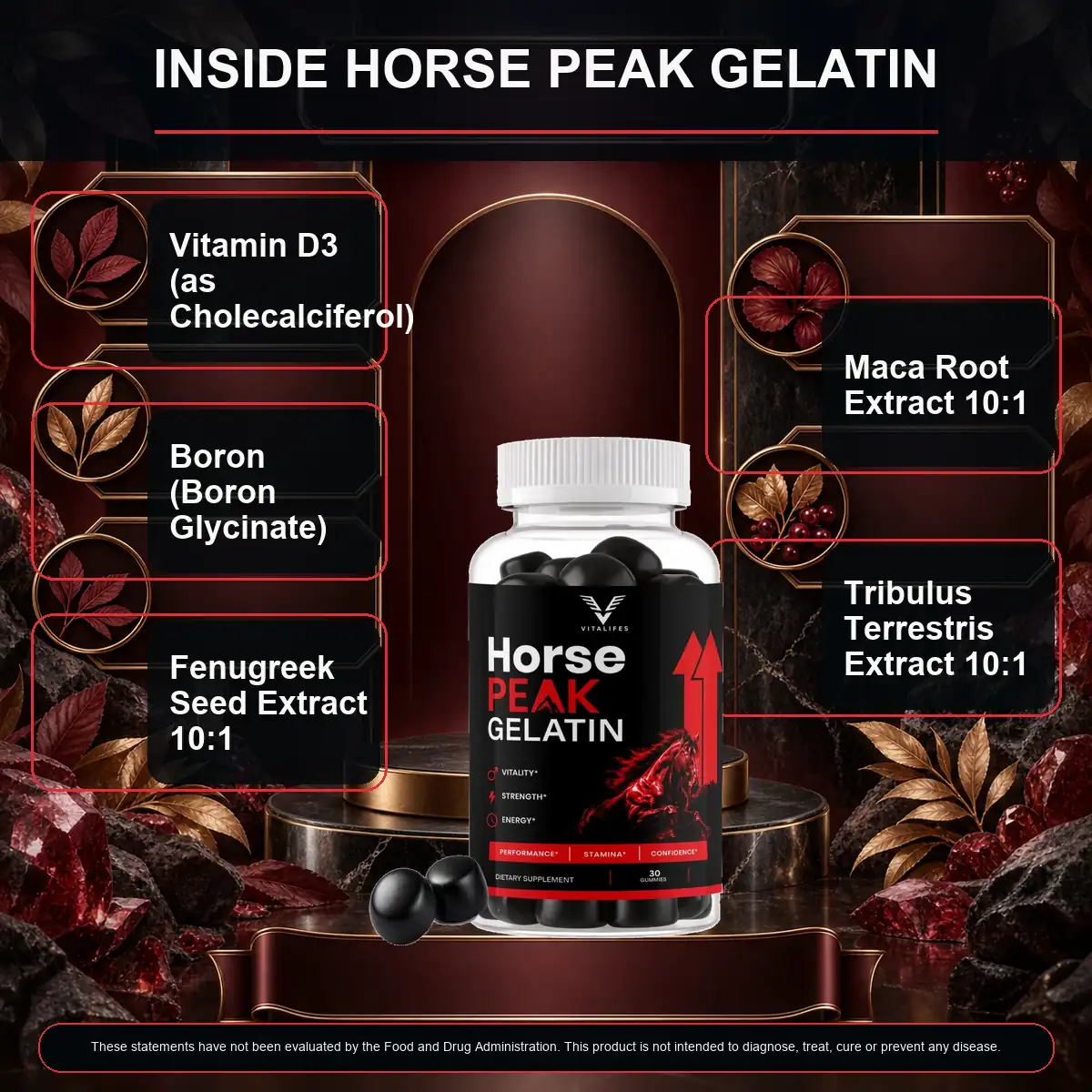
- Fenugreek seed extract 10:1 and maca root extract 10:1 are each printed at 100 mcg.
- The fenugreek trials used 600 mg a day of a standardised extract, which is 6,000 times the row.
- The maca trials used 1,500 to 3,000 mg a day, and a safety study ran 3 g a day.
- 100 mcg of a 10:1 extract works back to about 1 mg of raw herb.
- An allergy to fenugreek seed rules the gummy out at any dose.
- A dietary supplement, not a drug, with no FDA approval.
Check 1: What exactly does the label print for these two rows?
Fenugreek is printed as fenugreek seed extract 10:1, with its Latin name, Trigonella foenum-graecum L. Maca is printed as maca root extract 10:1, with the name Lepidium meyenii Walp. Both carry the same amount, 100 micrograms. The part of the plant is named for both: seed for one, root for the other.
Naming the part helps. A root and a leaf from the same plant are different raw materials with different chemistry. Beside the four botanicals, the label also prints vitamin D3 at 84 mcg and boron at 7 mg, so the amounts can be read side by side.
| Row | Printed amount | Form |
|---|---|---|
| Fenugreek seed extract | 100 mcg | 10:1 extract of the seed |
| Maca root extract | 100 mcg | 10:1 extract of the root |
| Vitamin D3 | 84 mcg, or 3,360 IU | Cholecalciferol |
| Boron | 7 mg | Boron glycinate |
Read from the Supplement Facts panel.
Check 2: What amounts did the trials use?
A label and a trial are only comparable when you set the figures next to each other. Here they are.
| Herb | On this label | What the published work used |
|---|---|---|
| Fenugreek | 100 mcg of a 10:1 extract | 600 mg a day of a standardised seed extract in both 12-week trials, and 600, 1,200 and 1,800 mg a day in a 2024 dose-ranging study |
| Maca | 100 mcg of a 10:1 extract | 1,500 to 3,000 mg a day for sexual desire, 2,400 mg a day of dry extract in men with mild difficulty, and 3 g a day in a safety study |
From the ingredients page of this website. The right column describes the trials. It is not a prediction for this gummy.
Matching one day of the 600 mg fenugreek trial would take roughly 6,000 of these gummies. That is 200 bottles. Maca is a food-dose herb, eaten as food in the Andes, which is part of why its trial doses are large and its safety record is reassuring. A study that gave 3 g a day found it acceptable. That says the material is mild. It says nothing about a hundred micrograms of it.
Check 3: What does 10:1 do to the sum?
The 10:1 mark describes how an extract was made. It tells you roughly how much raw plant went in. It does not tell you how strong the result is. The United States Pharmacopeia group's paper says plainly that such ratios cannot be verified by analysis, yet they are often used as if they measured strength.
Work it backwards anyway. A 100 microgram, 10:1 row stands for about one milligram of raw herb. That is less than a pinch of the spice in a curry. A teaspoon of fenugreek seed is about four grams.
- Neither row names a standardisation marker, such as a stated amount of a named compound.
- Standardisation, not weight, is what makes an extract row mean something.
- The trials that used fenugreek and maca used extracts and doses chosen by the researchers, not these amounts.
Our posts on what 10:1 means and what 100 micrograms of a herb buys have the longer version.
Want the full panel in front of you?
Every amount is printed on the bottle. The official checkout lists each pack with its price and the 60-day guarantee.
See today’s price and guarantee
Disclosure: this website earns a commission on orders placed through it. One gummy a day, 30 per bottle.
Check 4: What do safety and allergy look like at 100 micrograms?
At 100 micrograms the answer is simple. Nothing is documented at that amount beyond ordinary sensitivity. The maple-syrup smell that fenugreek is known for needs grams, not micrograms.
Allergy is the exception. It responds to the protein, not to the dose. If you are allergic to fenugreek seed, do not take a product that contains it at any amount. Fenugreek also carries a long traditional reputation in pregnancy, which is a reason for a pregnant or nursing woman to speak to a doctor.
On blood sugar, fenugreek has a documented effect in trials, but that evidence is built on gram doses. The practical figure for this gummy is the 3 g of total sugars. If you manage glucose with medicines, tell your doctor.
A toxicology summary of maca and a safety study at 3 g a day are on our source list. They describe the plant at large doses, not this gummy.
Check 5: What should you expect from these two rows?
Honestly, not much. The rows are small enough to be safe and small enough to do very little. The two doses that do work are vitamin D3 and boron. Fenugreek and maca are a botanical signature on the label.
That is not a criticism of the herbs. It is a note about amounts. A man who reads the panel that way will not be disappointed by it. A man who expected a fenugreek or maca trial dose from a gummy will be.
- Take one gummy a day and no more. The label asks you not to exceed the dose.
- Judge it at about day fifty and keep notes from the start.
- If the notes show nothing, the 60-day guarantee is there. Return postage is yours.
- Ask the order desk for the finished-product specification if you want more detail on the extracts.
A short safety line. Horse Peak Gelatin is not a drug and is not FDA approved, because no dietary supplement is. It is not meant to diagnose, treat, cure or prevent any disease. Ask a doctor about anything medical.
Where do these facts come from?
Label and policy facts come from the Horse Peak Gelatin bottle artwork, the distributor's own paperwork and the pages of this website. Outside sources are named below.
- The 600 mg Testofen trial in aging men. https://pubmed.ncbi.nlm.nih.gov/26791805/
- A 2024 dose-ranging trial at 600, 1200 and 1800 mg. https://pubmed.ncbi.nlm.nih.gov/39288153/
- The 600 mg libido trial. https://pubmed.ncbi.nlm.nih.gov/21312304/
- A meta-analysis of fenugreek and blood glucose. https://pubmed.ncbi.nlm.nih.gov/36837450/
- The NIH complementary health centre's fenugreek page. https://www.nccih.nih.gov/health/fenugreek
- The 1,500 and 3,000 mg maca trial. https://pubmed.ncbi.nlm.nih.gov/12472620/
- The 2,400 mg trial in men with mild erectile dysfunction. https://pubmed.ncbi.nlm.nih.gov/19260845/
- A 3 g/day safety and acceptability trial. https://pubmed.ncbi.nlm.nih.gov/27548190/
- A toxicological synopsis of maca. https://pubmed.ncbi.nlm.nih.gov/16042502/
- A systematic review of maca and sexual function. https://pubmed.ncbi.nlm.nih.gov/20691074/
- United States Pharmacopeia group's paper on extract ratios. https://pubmed.ncbi.nlm.nih.gov/36249773/
Frequently asked questions
How much fenugreek is in Horse Peak Gelatin?
The label prints fenugreek seed extract 10:1 at 100 micrograms per gummy. That works back to about 1 mg of raw seed.
How much maca is in Horse Peak Gelatin?
The label prints maca root extract 10:1 at 100 micrograms per gummy, which works back to about 1 mg of raw root.
How does that compare with the trials?
The fenugreek trials used 600 mg a day of a standardised extract. The maca trials used 1,500 to 3,000 mg a day, and a safety study used 3 g a day.
Does the fenugreek in the gummy affect blood sugar?
The documented effect comes from gram doses, far above this row. The 3 g of total sugars per gummy is the practical figure.
I am allergic to fenugreek. Can I take it?
No. An allergy responds to the protein, not the dose, so the gummy is not suitable at any amount.
Our view
Fenugreek and maca are two good herbs on a label at amounts too small to test. The printed panel makes that easy to see, which is a point in its favour: nothing is hidden in a blend.
Read the gummy as a vitamin D3 and boron product with a botanical signature. If that suits you, a simple 60-day test costs little. If you wanted trial doses of fenugreek or maca, look elsewhere and talk to your doctor.
Ready for a simple 60-day test?
The official checkout shows each pack with its price. The 60-day guarantee runs from purchase, so you can judge the rows for yourself.
See today’s price and guarantee
Disclosure: this website earns a commission on orders placed through it. One gummy a day, 30 per bottle.
Last updated October 29, 2026